By Will Olsen
What does it take? A question pondered by hundreds of thousands of athletes every day. Is it the grit and determination of Muhammad Ali, the relentless willpower that drove Michael Phelps to 23 gold medals, or the fierce competitiveness that carried Rory McIlroy to a career grand slam and back-to-back Masters victories? Or maybe it’s so much simpler; could it just be that drive and passion to do what they love every day?
I sat down with Hampton’s very own Lower Sixth academy rugby players: Toby, Stan and Seb, three guys quietly living that question every week.
Stan follows the Michael Phelps school of thought: relentless pursuit. Rugby, rugby, rugby. Getting home and throwing 200 passes because something felt just a bit off at training, spending evenings obsessing over footage of past games, keeping recovery compulsively on point. Toby has the grit Muhammad Ali was built on, 200 hooker throws as the benchmark, grinding in the gym for every extra rep, never leaving the practice field until it feels right. And Seb has that McIlroy competitiveness, a relentless need to be on the winning side in every contact, every shuttle run and every argument with his mates.
Now don’t get me wrong, they have a long way to go, but it gives you a feel for who these three are. Stan plays at Harlequins, where he has already earned call-ups to England camps. Toby is also at Quins and on the edge of Scotland caps. Seb is at Saracens looking for that U18 starting shirt. So, what’s it actually like: the highs, the lows, the stuff nobody tells you about living the academy rugby life?
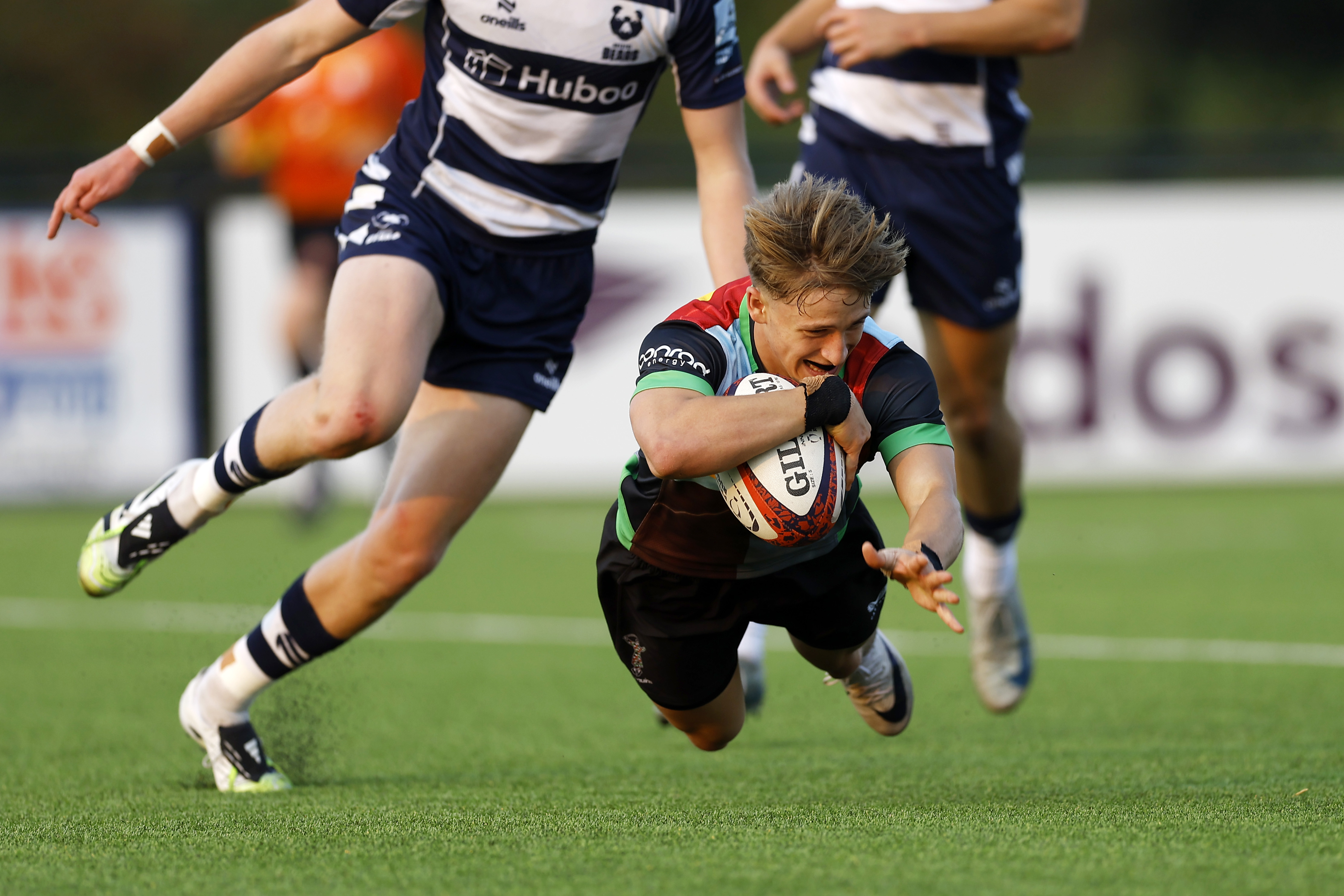
Ask any of them about their favourite academy memory and you immediately see why they do it. For Stan, it was a full-pitch try against Northampton in February: “I do regret not hitting a celly,” he admits. For Toby, it was his U18s debut against Yorkshire, scoring on his first appearance after just one week of training with the squad – a difficult feat at any level, let alone U18 academy. However, Seb’s moment came from a different place entirely, less about a single score and more about a mental breakthrough. It was a tense moment in a knife-edge contest, he got the ball and made a pivotal line break to change game, but that wasn’t the important bit. It was the feeling he had overcome the mental block of such high performance: “It showed me I was getting past it,” he says.
It is clear through all three that Hampton has shaped their academy careers in ways that go beyond rugby ability. For Stan it’s about confidence. Performing week in, week out for school gives him the platform to carry that form into Quins. Toby points to something more specific: getting used in different positions at Hampton has forced him to develop aspects of his game he wouldn’t otherwise have worked on, like ball-carrying and defending in wider channels from the back row. For Seb, who recently moved from London Irish to Saracens, Hampton gave him the licence to be a primary carrier, a role that has defined his identity as a player and that he has carried into life as a hooker at academy level.
The most revealing answers came when I asked about the hardest obstacles they’d faced. This is where the picture of academy rugby gets more complicated than the highlights reel suggests. Stan was dropped from the Quins 18s mid-season, having been involved all year. Being pushed back down to U17s stung: “it was annoying,” he says imaginatively. But he was able to use this as motivation and got himself back in the team. Toby, meanwhile, describes the mental challenge of walking into a U18s squad after one week of training and being expected to know the calls and match the intensity, however he knew he couldn’t have that mental block while playing at the top: “once I was actually in the game, everything seemed to click into place.”
Seb’s account is the most candid. For three years, he struggled to perform at the level he knew he was capable of, weighed down by his own self-criticism and the mental pressure he placed on himself. His confidence as a player took a real hit. “I recently have started to get past it,” he says – that ability to get back up and keep going starts to define the best.
Toby perhaps best captures the culture that makes this possible: “The pressure to perform isn’t measured by individual performances, it’s about how much you develop throughout the programme.” That reframe, from outcome to growth, is what keeps players like these three going through the difficult patches and helps players develop to such a high level.
And then there’s the small stuff that outsiders never see. At the end of every Saracens session, forwards and backs split into 2 groups; the backs have a chant, where one player goes “Jumulai,” then group responds “Jai” twice. Then the forwards, it’s “Beefy” and “Beef.” It sounds trivial. But in a world built on pressure, obstacles and the constant fear of being dropped, those small rituals are the glue.
The world is full of ‘wannabe’ superstars, but few are willing to do what it takes. To get up for those early sessions, reflect after a poor performance spell or get back up after being dropped. But these guys are doing it every day, bit by bit, and only time will tell if they really have what it takes.
Leave a Reply