By Alex Watson
On the surface, running is a simple sport. It requires no sort of equipment, teammates, or specific playing field – just a pair of trainers and a space to move in. Often, it feels easiest at a young age, when we are arguably at our most fearless and energetic.
But, for most of us, as we grow older, running, particularly the long-distance form, becomes less and less attractive, with the sport’s physical and mental workload steadily increasing. Many adolescents stop running as a sport altogether, some never returning to it, some picking it up again later in life. Very few continue to derive satisfaction from it during their teenage years, or have the motivation to run consistently.
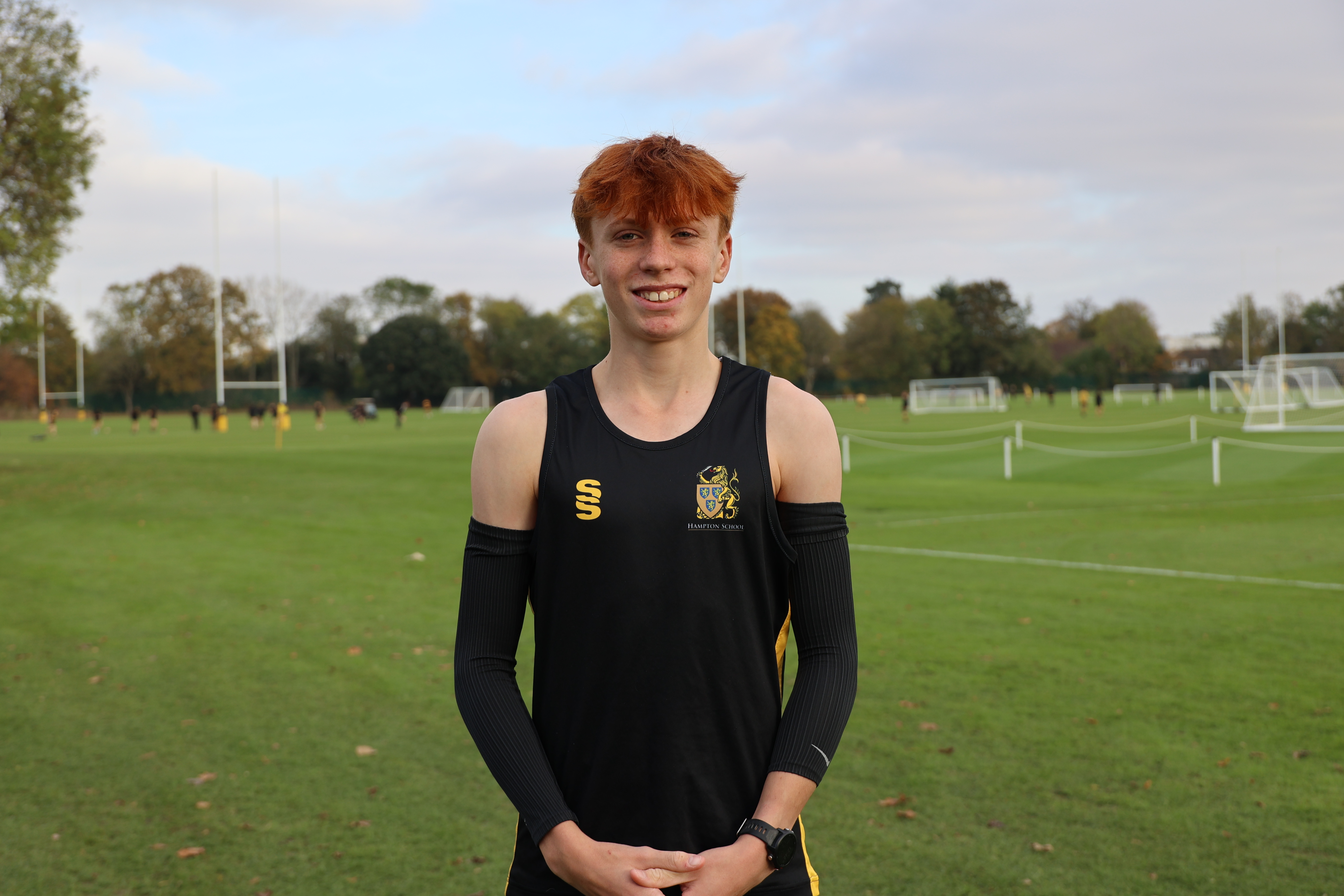
Lower Sixth Hamptonian Marcus Solomon is one of those few, however. Having competed at the highest level of cross country and long-distance running for a number of years – recording top 10 finishes in national races from as early as 13 – he recently attained his most impressive achievement to date, becoming a National Road Relay champion on 4th October 2025, as part of the St Mary’s Richmond AC team (and missing out on the course record by just one second). This was followed just five days later by a strong second place finish in the Middlesex Cross Country Championships, of which he is a three-time champion. Two days on from that, he was winning his third Bushy Parkrun with a 5k time of 15:42.
Such an accomplished list of accolades, both in and outside of school, is no mean feat, and Solomon has both talent and hard work to credit for his successes. Surprisingly, he did not see running as his main sport until the age of 12 or 13, when he began to realise how good he was for his age and chose to prioritise it over football. However, once this shift had occurred, it quickly became a central part of his life, as he chose to join St Mary’s Richmond AC in Year 9, a decision which prompted a significant increase in the frequency, intensity and seriousness of his running. Over the years, this trajectory has continued to increase through his runs with the club; he now trains with the St Mary’s University endurance group, covering at least 80-90 km every week and running almost daily.
This huge workload wouldn’t be possible without high-level coaching, a like-minded, motivating community of runners and a considerable amount of both physical and mental strength. While Solomon can access the first two through his athletics club, the latter comes entirely from himself, with his psychological resolve particularly important in separating him from the average runner. He recognises that the sport is very tough and hated by many, but finds the gratifying feeling at the end of each run a worthy reward for its difficulty, as well as liking its social aspect and the constant feeling of improvement it provides.
Simply enjoying and persevering with the running itself is not enough, however. Solomon also must fit his very full schedule around other sporting, academic and social
commitments, which can prove extremely challenging as he’s often required to make sacrifices and frequently finds himself playing full, high-intensity football matches straight after very long runs on Saturdays. This not only makes Solomon’s life more complicated and mentally tiring, but also can lead to a number of physical setbacks, often in the form of poor races but most significantly through injuries. These can take away weeks of progress in a second, forcing him to stop training and competing. It’s no surprise that, alongside the progress he’s made, one of his proudest achievements in running is simply not quitting.
This is something he wishes more people would do, as he believes that it’s important for people, particularly young children, to keep healthy and active, and that the payoff and sport itself can actually be very enjoyable if not taken too seriously. The encouraging recent growth of running as a sport, both in the UK and elsewhere, would suggest that others are beginning to align themselves with Solomon’s ideas.
Looking to the future, Solomon is confident that his running journey will continue after Hampton, though he is unsure of what path it will take. The school has certainly been a significant part of it, however, allowing him to compete at various standards and providing a pathway to national level. Former teacher and Olympian David Clarke has played a big role in his athletics career, giving him important advice, as well as company, in his first few years at Hampton.
Ultimately, however, while many people can be thanked for contributing to Solomon’s success, his many triumphs – winning national relays and Parkruns, competing at the highest level of school cross-country, and much more – are primarily a result of his constant hard work, desire to improve and dedication to his sport. He may be uncertain about what’s to come in his running career – and he’s still got over a year left at Hampton before he needs to decide – but it’s fairly obvious that he has a bright future ahead.
Leave a Reply